
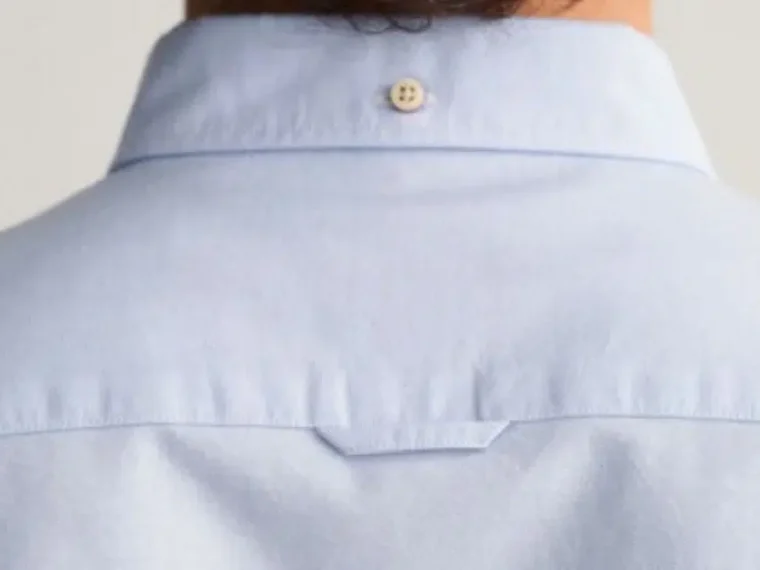
So you know that little loop on the back of some button-down shirts? It’s just below the collar. For most people, it is so little you might not notice it until you’re looking for it. Have you ever thought about what it is there for? I know I never did. I even asked my husband because some of his shirts have these tiny loops. He had no idea, staring at those loops with surprised eyes. He said he had never noticed them before. For the longest time, I thought it was some odd by-product of the factory whatever mundane purpose it must have been for (if it was intended to serve any kind of purpose). Turns out, not really. That small piece of fabric has a pretty cool story to it anyway.
So, let’s roll back, way back to the early 1900s when the loop was not some fashion addition, but an actual, functional accessory. You have sailors in the U.S. Navy. They live in cramped quarters on a ship, with no personal space, and no walk-in closets (cloaks?). The uniforms (dress uniforms) needed durability, usage efficiency, and easy stowing and securing in tight quarters. Thus, the loop.
It is referred to as a “locker loop” (or sometimes “backstay loop”), because it allows sailors to hang their uniforms on hooks. Easy as that. Sailors were hanging their shirts, on hooks, not hangers or shelves, just a hook, a peg, and this little loop. So the navy with this incredibly simple design kept their shirts off the deck and wrinkle-free. This goes a long way when you are trying to avoid looking like you fell asleep in your dress uniform.
You cannot hate me for thinking this was a truly great piece of design! Something so simple that actually worked. I mean there is nothing difficult about it, it is not rocket science or some amazing technology?! Just a loop of fabric on the back of a shirt. However, on a rocking ship when space was a premium and storage was a complete mess, that little loop was just a tiny bit of ease.

Apparently, it stuck.
Now this is where the story turns from practical to preppy. A couple of decades later and suddenly this loop is no longer a Navy thing—it is on campuses, especially Ivy League campuses. And the students there—who certainly were not living on boats—begin wearing shirts with loops.
Their reason for having the loop was not for a locker hook; it was for fashion!
There’s a big story that Ivy League dudes liked the look and maybe even the symbolism; it was like they projected some subtle maritime, classic Americana something or other.
And from there it just… took off. The loop became a THING. It became a hallmark of a particular type of style: clean, polished, and somewhat nerdy in an endearing way. You know, all those spiffy Oxford button down shirts with khakis and loafers.
And it spread! Designers started using it as a detail even when it did not have any functional use. At that point, no one was hanging shirts on pegs in small lockers but the loop lived on regardless. It was a little tip of the hat to tradition. People recognized it even if they weren’t sure why it was there.
Not only that, but it is still incredibly practical today! Not in the practical way. You are probably not hanging your dress shirts on the random hooks cluttering your apartment. But for a person who travels a lot? That little loop is clutch. You can hang your shirt on the back of a hotel bathroom door, or, even in a garment bag, and it helps you keep it somewhat wrinkle-free without a hanger. Basically, it is extraordinarily useful in a very subtle way that you never think about until you are stuffing shirts in a suitcase and you realize: oh, hey, I can just hang this one up by the little loop thing.
Then there’s the style aspect. At some point, the design world decided to embrace the loop as a subtle design touch, and you’ll see brands playing with the loop: different colors, maybe a little contrast stitching, or maybe a unique fabric just for the loop. Sometimes it’s the kind of thing that only someone super into menswear would notice. For some people, it becomes sort of a trademark, almost a little flag for their style or brand loyalty.

There’s even a funny rumor I came across while looking into all this—total urban legend stuff—but apparently, back in the day, a guy at my school used to cut the loop off his shirt to communicate that he was “taken.” Like, not available to date. Loop gone, means in a relationship. And his girlfriend would wear his college pin. Romantic? Probably. A little possessive? Also probably. I can’t imagine it’s something people still do, but interesting, right?
Anyway, these days, if your shirt has a loop on it, it’s probably just a matter of where and what you bought. Some brands always include a loop, some brands never include a loop. But if you have a shirt hanging in your closet with a loop on it, now you know that it’s not just some weird extra piece of fabric. It has a history: navy uniforms, Ivy League trends, accidental evolutionary fashion—it’s all wrapped up in that little loop.
So there you have it. I told my husband and he was so shocked he had a funny look on his face. Next time you put on a button down and you feel a small tab lightly brushing against the back of your neck, you’ll know that tab is a little piece of history. And you might even use it next time you are getting ready for a trip.