
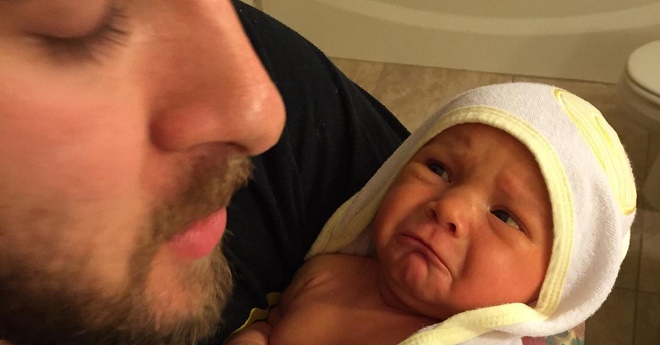
The arrival of a newborn is one of the happiest moments in a parent’s life. After months of waiting, preparing, and imagining what their little one will look like, parents finally get to hold their precious baby in their arms. Naturally, they want to capture every moment.
From the first smile to the tiniest fingers and funniest facial expressions, every little detail feels worth remembering. And in today’s world, many parents love sharing these special moments with friends and family on social media.
But one father discovered that sharing a simple photograph of his newborn daughter could turn into something far more important than collecting likes and funny comments. What started as an adorable post quickly became a frightening experience — and one stranger’s observation may have made all the difference.
A Sweet Baby Photo That Made Everyone Smile
One day, the father was spending some time playing with his baby girl when she made an unusually funny facial expression. It was one of those adorable little moments that parents immediately want to capture.
He thought her expression was hilarious and incredibly cute. Wanting his friends and family to enjoy it too, he took a picture and uploaded it to social media.
As expected, the photograph attracted plenty of attention. People loved the baby’s expression, and the comment section quickly filled with jokes, compliments, and playful predictions about what kind of personality she might have as she grew older.
One person jokingly wrote:
“She’s going to be a rebel and marry a penniless guy without tattoos.”
The father enjoyed reading the humorous reactions. Like many proud parents, he was simply happy that people were sharing in his joy.
But among all the funny remarks was one comment that immediately changed the mood.
A Doctor Noticed Something Others Had Missed
One person looking at the photograph noticed something unusual about the baby’s appearance. Rather than commenting on her funny expression, this person focused on her eyes.
The comment read:
“Are her eyes a little yellow? It looks like it to me, but it’s hard to tell, because the entire photo is a little yellow. It’s probably nothing, but it could be a symptom for neonatal jaundice. If her skin and eyes actually look a little yellow, then maybe you should get it checked out. I’m a paranoid children’s doctor, hence my concern.”
It was a cautious observation, not a diagnosis. The commenter even acknowledged that the lighting in the photograph could be misleading.
Nevertheless, the possibility was serious enough to make the father stop and think.
Could his little girl really have a medical condition that he had not noticed?
Instead of dismissing the comment, he decided to take action.
The Father Took His Baby to the Hospital
Concerned by the doctor’s observation, the father took his daughter to the hospital to have her examined.
What happened next confirmed that the comment deserved attention: according to the story, the baby was diagnosed with newborn jaundice.
The father had originally uploaded the picture simply because he thought his daughter’s expression was adorable. He never imagined that someone looking at it online might notice a potential health concern.
The story is a powerful reminder that even an ordinary photograph can sometimes prompt someone to notice something worth checking.
It also highlights the importance of taking concerns about a newborn seriously. Babies cannot explain when something feels wrong, and some medical conditions may not be obvious to parents at first.
What Exactly Is Newborn Jaundice?
Newborn jaundice, medically known as neonatal jaundice, is a common condition that causes a baby’s skin and the whites of their eyes to appear yellow.
It happens when a substance called bilirubin builds up in the baby’s blood.
Bilirubin is a yellow pigment produced naturally when the body breaks down old red blood cells. Normally, the liver processes bilirubin so that the body can eliminate it.
However, a newborn’s liver is still developing and may not be efficient enough to remove bilirubin quickly. As a result, the substance can accumulate in the blood and cause the characteristic yellowish color.
Jaundice is particularly common during the first few days after birth. Many newborns develop a mild form of it, and most recover without complications.
However, the condition should never be ignored when a baby appears yellow. A healthcare professional can determine whether the bilirubin level is safe or whether treatment is necessary.
Why Do So Many Newborn Babies Develop Jaundice?
There are several reasons why newborns are especially vulnerable to jaundice.
1. An immature liver
A newborn’s liver is not yet fully developed. During the first days of life, it may struggle to process bilirubin as efficiently as an older baby’s liver.
This is one of the most common reasons for physiological newborn jaundice.
2. The natural breakdown of red blood cells
Babies have a relatively high number of red blood cells at birth. As their bodies begin replacing these cells, bilirubin is produced. If the liver cannot remove it quickly enough, levels may rise.
3. Feeding difficulties
Some newborns do not initially receive enough milk, particularly when breastfeeding is still being established. When a baby takes in too little milk, they may have fewer bowel movements, making it harder for bilirubin to leave the body through their stools.
Frequent feeding and appropriate support with breastfeeding can help, but a baby with suspected jaundice still needs medical assessment.
4. Premature birth
Babies born prematurely are more likely to develop jaundice because their livers are less mature than those of babies born at full term.
5. Blood group incompatibility
In some cases, differences between the mother’s and baby’s blood groups can cause the baby’s red blood cells to break down more quickly. This can lead to higher bilirubin levels and require closer monitoring.
The Warning Signs Every New Parent Should Know
CONTINUE READING IN PAGE 2