

Disclaimer: The information provided in this article is strictly for general educational and informational purposes only and is not intended as medical, nutritional, or botanical advice. We do not diagnose, treat, cure, or prevent any disease or health condition, and we do not take any responsibility or liability for any side effects, allergic reactions, misidentifications, or negative outcomes resulting from the harvesting, preparation, or use of the plants and recipes described here. Foraging wild plants carries serious risks of misidentification with poisonous lookalikes. Always consult a qualified healthcare professional, doctor, or pharmacist before introducing new wild plants, seeds, or herbal teas into your diet, especially if you are pregnant, nursing, taking prescription medications, or managing an existing medical condition such as kidney stones or kidney disease. Always verify wild plant identification with a certified local botanist or foraging expert before consuming any wild-harvested plant.

Common purslane (Portulaca oleracea) is one of the most misunderstood plants in the world. Millions of gardeners pull it out of vegetable beds and sidewalk cracks every summer without realizing they are throwing away a top-tier nutritional food.
While it grows fast and survives harsh drought like a common weed, purslane is actually a succulent leafy vegetable eaten across the Mediterranean, the Middle East, Asia, and Mexico for thousands of years. It has a crisp, juicy texture and a mild, lemon-like flavor that works in everything from fresh salads and pestos to boiled side dishes, winter pickles, and herbal teas. Every part of the plant that grows above the ground—the leaves, the tender stems, the yellow flower buds, and the tiny black seeds—is completely edible and packed with nutrients.
How to Identify Common Purslane Safely
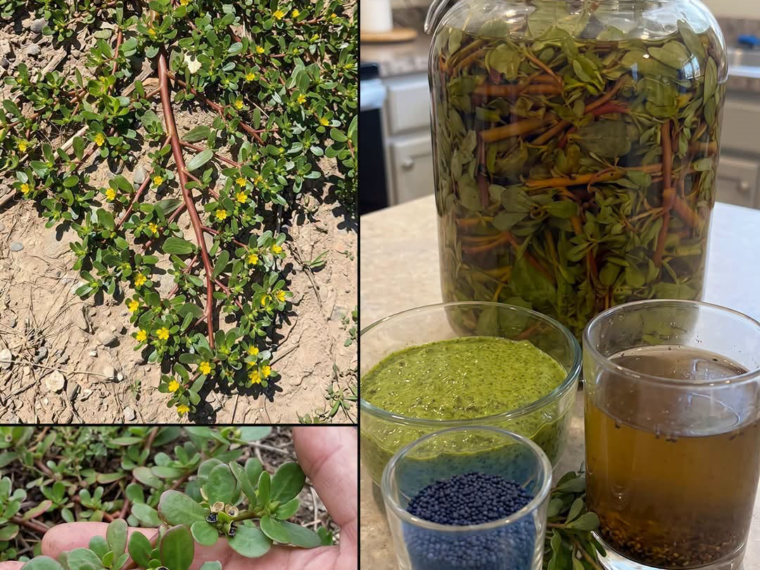
Before using any wild plant at home, you must identify it with total certainty. Purslane is easy to recognize once you know what to look for, as it has distinct succulent features that help it store water during hot weather.
- Growth habit: The plant grows flat along the ground in a spreading circular mat, usually reaching 5 to 15 centimeters in height and spreading up to 40 centimeters wide.
- Stems: The stems are round, smooth, thick, and hairless, with a distinct reddish or purple tint that stands out against the soil.
- Leaves: The leaves are thick, fleshy, hairless, and shaped like flat teardrops or small paddles, growing in clusters near the ends of the stems.
- Sap: When you snap a purslane stem or leaf in half, the liquid inside is completely clear and slightly thick, never white or milky.
- Flowers: Small yellow flowers with five notched petals open only for a few hours on sunny mornings in the center of the leaf clusters.
- Seed pods: After the flowers close, tiny round green capsules form and eventually split open around the middle to reveal dozens of tiny black seeds.
Warning: How to Avoid the Toxic Lookalike (Spotted Spurge)
Common purslane often grows right next to a poisonous weed called spotted spurge (Euphorbia maculata). You can easily tell them apart by checking three clear differences every time you harvest.
- Check the sap: Break the stem open; spotted spurge leaks a milky white sap that can irritate your skin and stomach, while purslane has clear watery juice.
- Check the stems: Purslane stems are thick, fleshy, and totally smooth, while spurge stems are very thin, wiry, and covered in tiny fine hairs.
- Check the leaves: Purslane leaves are thick and juicy without markings, whereas spurge leaves are paper-thin and often have a dark red spot in the middle.
Why Purslane Tastes Different Depending on the Time of Day
One unique fact about common purslane is that its flavor changes between morning and evening. Because purslane grows in hot, dry places, it keeps its leaf pores closed during the heat of the day to save water and opens them at night to breathe.
- Morning harvest: At night, the plant converts carbon dioxide into malic acid, giving leaves picked in the early morning a bright, sour, green-apple tang.
- Afternoon harvest: During sunny days, the plant breaks down that stored acid for energy, making leaves picked in the late afternoon much milder and less sour.
Nutritional Power and Health Benefits of Purslane
Common purslane holds more nutrition than almost any standard supermarket salad green, including iceberg lettuce and spinach. Because it has deep taproots that pull minerals from compact soil, it concentrates valuable compounds inside its juicy leaves and stems.
- Rich in Omega-3 fatty acids: Purslane contains more alpha-linolenic acid (ALA) than any other leafy vegetable, delivering five times more omega-3s than spinach.
- Contains trace EPA: Unlike almost all other land plants, purslane contains small amounts of eicosapentaenoic acid (EPA), a healthy fat usually found only in fish and algae.
- Supports heart health: The plant omega-3 fats and potassium work together to support healthy cholesterol levels, flexible blood vessels, and normal blood pressure.
- High in Vitamin A: It provides high levels of beta-carotene, which the body uses to maintain sharp eyesight, healthy skin, and strong immune defenses.
- Packed with Vitamin C and Vitamin E: These two natural antioxidants protect cells from daily wear and tear while helping the skin repair itself.
- Loaded with essential minerals: Every handful supplies magnesium, potassium, calcium, and iron, which are necessary for strong bones, steady energy, and muscle recovery.
- Contains betalain pigments: The reddish stems and yellow flowers hold betalains, the same protective plant compounds found in red beets that help reduce internal stress.
- Natural source of melatonin and glutathione: Purslane naturally contains glutathione for liver support and melatonin, a compound that helps regulate normal sleep cycles.
- Soothing digestive fiber: The thick, gel-like juice inside the leaves is called mucilage, a soluble fiber that coats and calms an irritated stomach and feeds good gut bacteria.
- High water content for hydration: Because the leaves are over 90 percent water locked inside a cellular gel, eating purslane helps hydrate the body during hot summer weather.
The Power of Purslane Seeds: Benefits and How to Use Them
While most people focus only on the leaves and stems, purslane seeds have been prized in traditional herbal systems for centuries. A single healthy purslane plant can produce tens of thousands of tiny, hard black seeds over a single summer.
Benefits of Purslane Seeds
- Concentrated healthy fats and protein: The seeds store the plant’s energy reserves, providing a dense dose of linoleic and alpha-linolenic fatty acids along with plant protein.
- Digestive and urinary comfort: In traditional herbal practices, the seeds are used for their cooling, soothing nature to calm mild digestive heat and support urinary tract comfort.
- High soluble fiber: When soaked in liquid, the seeds release a mild gel similar to chia or flax seeds, which helps slow down sugar absorption after meals.
- Rich in plant sterols and antioxidants: The dark seed coats contain protective polyphenols that support healthy blood lipid levels and overall cellular vitality.
How to Harvest Purslane Seeds at Home
Harvesting your own purslane seeds is simple and costs nothing if the plant grows in your garden.
- Wait until late summer when the base of the purslane stems looks thick and small round seed capsules appear where the yellow flowers used to be.
- Cut several mature stems near the base in the afternoon when the plant is dry from the morning dew.
- Place the cut stems inside a large paper grocery bag or spread them out on a clean baking sheet lined with parchment paper in a warm, dry room.
- Leave the stems to dry for five to seven days; as the plant dries, the tiny seed capsules will naturally pop open and drop their black seeds.
- Shake the dried stems vigorously inside the bag or over the tray to release all remaining seeds.
- Pour the contents through a fine mesh kitchen strainer to separate the tiny black seeds from the dried leaves and stem pieces.
- Store the completely dry seeds in a sealed glass jar in a cool, dark cupboard, where they will stay fresh for up to three years.
How to Use Purslane Seeds at Home
- Raw seed topping: Sprinkle half a teaspoon of raw seeds over morning oatmeal, yogurt, cottage cheese, or green salads for a mild nutty crunch.
- Soaked seed drink: Stir one teaspoon of seeds into a glass of warm water or juice and let sit for 15 minutes before drinking to soothe the stomach.
- Ground into flour: Grind the dry seeds in a spice grinder or mortar and pestle and mix a spoonful into bread dough, pancakes, or homemade crackers.
- Blended into smoothies: Toss a teaspoon of whole seeds into a blender with fruit and water to boost the fiber and omega-3 content of your drink.
How to Clean and Prepare Fresh Purslane
Because purslane grows flat against the dirt, soil and sand easily stick to the undersides of the leaves and stems. Cleaning it properly ensures a crisp, grit-free meal.
- Cut off the tough root base and discard any bruised or yellowing lower leaves.
- Fill a large bowl with cold water and stir in one tablespoon of salt or two tablespoons of white vinegar.
- Submerge the purslane stems and swish them around gently with your hands for one minute so the heavy dirt sinks to the bottom.
- Lift the greens out of the bowl rather than pouring the water over them, then rinse once more under cold running tap water.
- Pat the greens dry with a clean kitchen towel or spin them in a salad spinner before using.
5 Homemade Ways to Use Purslane
1. Fresh and Raw in Everyday Meals
Eating purslane fresh preserves all of its heat-sensitive Vitamin C and keeps its satisfying crunch intact. Both the leaves and the tender upper stems should be used.
- Green salads: Toss whole purslane leaves with chopped tomatoes, cucumbers, red onion, feta cheese, olive oil, and lemon juice for a classic Greek-style salad.
- Sandwiches and wraps: Use fresh purslane sprigs instead of lettuce inside burgers, tacos, and deli sandwiches for extra crunch that does not wilt quickly.
- Cool yogurt dip: Finely chop one cup of fresh purslane and stir it into thick plain yogurt with grated garlic, salt, and a drizzle of olive oil.
- Green smoothies: Blend a handful of fresh purslane with green apple, cucumber, lemon juice, and cold water for a hydrating summer drink.
2. Boiled Purslane (And Why Boiling Matters)
Boiling purslane is one of the best ways to prepare it, especially if you want to eat large portions. Cooking it briefly softens the stems and removes most of the soluble oxalates found in the raw plant.
Ingredients:
- 4 cups fresh purslane (leaves and tender stems, washed)
- 1 liter water
- 1 teaspoon salt
- 2 tablespoons extra-virgin olive oil
- 2 cloves garlic, finely minced or crushed
- Juice of half a lemon
Step-by-Step Instructions:
- Bring the water and salt to a rolling boil in a medium pot.
- Drop the washed purslane into the boiling water and press it down with a spoon so it is fully submerged.
- Boil uncovered for 3 to 4 minutes until the stems are tender when pierced with a fork, taking care not to overcook it or it will become overly slimy.
- Pour the purslane into a colander to drain well, and discard the cooking water (this removes the bitter oxalic acid that leached into the water).
- Transfer the warm greens to a serving bowl and toss immediately with the olive oil, minced garlic, and fresh lemon juice.
Bonus Soup Tip: If you chop raw purslane and boil it directly inside vegetable soups, bean stews, or curries for 15 minutes, its natural mucilage will gently thicken the broth just like okra does.
continue reading in page 2


