
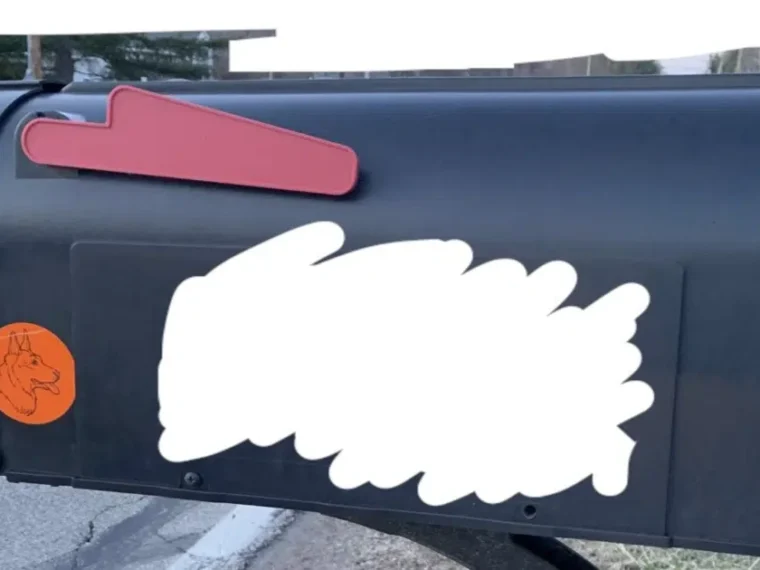
I was out walking last week when I noticed that my neighbor had a small orange paw print sticker on her mailbox flag. I initially assumed that she must have put the sticker on as a decorative item. And possibly to show her appreciation for her golden retriever. But I noticed the same sticker on two other mailboxes down the block. Therefore, I became curious as to what the sticker represented. I found out that the sticker didn’t represent anything cute at all. As a result, my entire perspective on how mail carriers view dogs has forever changed. In addition, how we all view safety in our communities has forever changed.
What the Orange Paw Print Stickers Really Represented
The orange paw print stickers were not decorations at all. Prior to 2020, the United States Postal Service (USPS) conducted a pilot program to test a visual alert system in certain geographic locations. They used stickers on mailboxes with specific colored paw prints. The basic idea of the program was to provide mail carriers with advance notice that a dog was living on or adjacent to a property. This was before the carrier arrived at the mailbox.
In areas where the program was piloted, the stickers were available in several colors. Each representing a different type of situation. For example, an orange paw print indicated that a dog lived at the specified address. A yellow paw print indicated that a dog lived immediately next door to the address. These stickers were used simply as a visual indicator. As a result, they gave mail carriers an opportunity to be aware of the presence of a dog. They could then be prepared to deal with any possible reaction from the dog to the mail carrier’s approach to the mailbox.
Even the most well-behaved dogs can react aggressively or irrationally when a stranger enters their territory. The stickers provided mail carriers with a sense of security. In addition, they allowed them to prepare themselves for a possible reaction from a dog.
This pilot program was a localized effort and not a national program. As such, not all mail carriers or residents were exposed to these stickers. Furthermore, they were not intended to be a permanent or universal method for providing advance notice to mail carriers.

Are the Paw Print Stickers Still Used Today?
One of the more surprising aspects of this story is that although the USPS stopped using the stickers as part of an active program, many residents are still seeing these stickers on mailboxes in their area. There is no indication that USPS is continuing to use the stickers as part of a current or ongoing program. It appears that once installed by a resident, the stickers were left in place by the residents who placed them on their mailboxes. The stickers appear to be a relic of the past. They were replaced by the USPS with new technology.
Prior to the pilot program, mail carriers relied on stickers to identify properties where a dog may reside. The stickers were installed by residents. And provided mail carriers with a heads-up regarding the presence of a dog at a property. Today, mail carriers rely on digital systems on their handheld devices. These provide them with information regarding potential hazards associated with a property. This includes the presence of a dog.
When a mail carrier uses their handheld scanner to scan an address for delivery purposes, they will typically be able to obtain information regarding the presence of dogs. And other hazards at the property they are delivering to. This information is received electronically. As a result, it provides the carrier with the ability to prepare for any possible reaction from a dog to their approach to the mailbox.
As such, the stickers were only an interim measure to assist carriers in identifying potential hazards; associated with a property until a more efficient and cost-effective alternative could be implemented.
Why Dog Awareness Matters for Mail Carriers
You may ask yourself why the USPS would invest the resources required to implement a pilot program utilizing stickers to inform mail carriers of potential hazards associated with a property. The answer is quite simple: dogs are one of the most common hazards faced by mail carriers. Many dogs that appear to be well-behaved and non-threatening at home may behave erratically. Or protectively when an unknown individual approaches the front door or mailbox.
As mail carriers travel throughout the course of a single day, they visit the same addresses multiple times a week. Carriers are trained to recognize and respond to potential hazards. But the level of uncertainty associated with interacting with potentially unpredictable animals is one of the primary challenges of their profession.

By knowing whether or not a dog resides at a given address, mail carriers can better manage their interactions with those animals. And minimize the likelihood of a negative interaction between a carrier and a dog.
Additionally, by knowing whether or not a dog resides at a given address, mail carriers can better prepare for potential interactions with dogs. And reduce their overall exposure to potential risks.
While considering this issue from the perspective of mail carriers, I began to realize the amount of trust we have placed in individuals who deliver mail to our homes. I also realized how little we consider their safety while performing their duties.
What to Do with a Paw-Print Sticker on a Mailbox
If you see a paw-print sticker on a neighbor’s mailbox, you should not interfere with it in any way. The sticker represents the property of the person whose mailbox it is on. Additionally, it continues to serve as a visual reminder for anyone approaching the residence to be aware of the presence of a dog.
If you find a paw-print sticker on your own mailbox and would rather not have it, you certainly have the right to remove it. The USPS is no longer distributing the stickers as part of an active program. Therefore, there is no obligation to maintain the sticker on your mailbox.
On the other hand, some homeowners continue to display the stickers as a way of indicating to anyone approaching the property that a dog is present. This is done as a courtesy to others and does not indicate that a dog poses a threat to visitors.
How I Discovered Ways You Can Support Your Mail Carrier
continue reading in page 2