Cicadas in the Garden: Should You Really Be Worried?
If you suddenly notice dozens—or even hundreds—of cicadas crawling around your garden, climbing trees, or leaving their papery shells behind, your first reaction might be to worry about your plants.
After all, cicadas can look intimidating. They are large, noisy insects, and when they emerge in large numbers, they can cover tree trunks, fences, patios, and even garden plants.
But are cicadas actually garden pests?
Usually, no.
For most established gardens, cicadas are more of a temporary nuisance than a serious pest problem. They generally do not chew holes in leaves, destroy flowers, eat vegetables, or attack garden produce. Adult cicadas feed only lightly on plant fluids, and healthy mature trees can usually tolerate them without significant long-term damage.
However, there is one important exception: young trees and shrubs can be damaged when female cicadas lay their eggs in small branches.
Understanding what cicadas actually do—and which plants are most vulnerable—can help you protect your garden without wasting money on unnecessary insecticides or pest-control treatments.
What Are Cicadas?
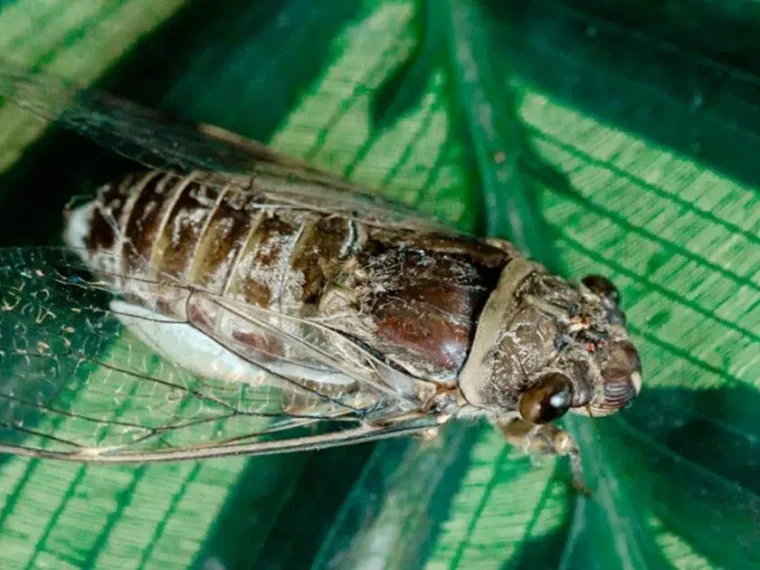
Cicadas are insects known for their distinctive buzzing and clicking sounds, especially during warm weather.
They spend a large portion of their lives underground as nymphs, where they feed on fluids from plant roots. When they mature, they emerge from the soil, climb onto trees or other vertical surfaces, shed their old exoskeleton, and become winged adults.
The familiar empty cicada shells you find attached to tree trunks are the discarded skins of these immature insects.
Different species have very different life cycles. Some cicadas emerge every year or every few years, while periodical cicadas can remain underground for 13 or 17 years before emerging in large numbers.
Once above ground, adult cicadas have a relatively short life. Their primary goals are to mate and reproduce.
And that is where the main garden damage can occur.
Are Cicadas Bad for Your Garden?
The good news is that cicadas are not generally considered serious garden pests.
Adult cicadas don’t normally eat your vegetables, flowers, or fruit. The U.S. Environmental Protection Agency notes that adult cicadas do not eat leaves, flowers, fruits, or garden produce. Instead, they consume small amounts of sap from trees and shrubs.
This means you generally don’t need to panic if you see cicadas sitting on:
- Tomato plants
- Pepper plants
- Herbs
- Flower beds
- Vegetable gardens
- Shrubs
- Garden fences
- Patio furniture
- Garden structures
They may simply be using these surfaces while they move around after emerging.
In fact, extension specialists generally recommend leaving adult cicadas alone rather than trying to eliminate them with pesticides.
Why Do Cicadas Damage Trees?
The biggest concern isn’t what adult cicadas eat.
It’s what female cicadas do when they lay eggs.
Female cicadas use a specialized egg-laying structure called an ovipositor to make small cuts or slits in twigs and branches. They deposit their eggs inside these openings.
They tend to favor relatively small branches—often around pencil thickness.
Those wounds can weaken the branches. Eventually, the tips of affected branches may wilt, turn brown, and die. This phenomenon is often called flagging.
This can make a tree look much worse than it actually is.
You might look into your garden one morning and see several brown branch tips hanging from an otherwise healthy tree.
Don’t automatically assume the entire tree is dying.
For a mature, healthy tree, losing some small branch tips is usually something it can tolerate and recover from.
Young Trees Are the Biggest Concern
If there is one group of plants you should pay attention to during a major cicada emergence, it’s young and newly planted trees.
A mature tree has a large canopy with plenty of branches that are too thick for female cicadas to target.
A young tree, however, may consist largely of thin branches in exactly the size range cicadas prefer for egg laying.
That means a heavy infestation can affect a much larger percentage of a young tree’s canopy.
University of Illinois Extension notes that mature, healthy trees generally tolerate this damage, while newly planted and smaller trees can be more seriously affected. Trees with roughly one-third or more of their canopy damaged deserve particular attention.
Young fruit trees can be especially worth protecting.
Which Trees Are Most Vulnerable?
Cicadas can lay eggs on many types of trees, but some are particularly susceptible.
Common examples include:
- Apple trees
- Cherry trees
- Peach trees
- Pear trees
- Oak trees
- Maple trees
- Hawthorn
- Redbud
- Dogwood
- Hickory
- Other young deciduous trees
University of Maryland Extension reports that cicadas have been known to lay eggs on more than 200 types of trees, with oaks, maples, cherries, and other fruit trees among commonly affected plants.
This doesn’t mean every tree in your garden needs protection.
Age and size matter enormously.
A large established oak is very different from a recently planted young apple tree.
What About Vegetable Gardens?
This is one of the biggest misconceptions about cicadas.
If cicadas are crawling through your vegetable garden, you generally do not need to cover your vegetables with insect netting specifically to protect them from cicadas.
Cicadas aren’t going to suddenly destroy your tomatoes, peppers, lettuce, cucumbers, zucchini, or other garden produce.
They may land on plants temporarily, but this does not mean they’re feeding aggressively on them.
Extension experts specifically note that vegetable gardens generally don’t require protection from cicadas.
So if you see a cicada sitting on a tomato plant, there’s usually no reason to grab the pesticide.
Do Cicadas Eat Plant Leaves?
No—not in the way many people imagine.
Cicadas are not leaf-chewing insects like caterpillars, grasshoppers, or certain beetles.
Adult cicadas use piercing and sucking mouthparts to obtain plant fluids. Their feeding is generally not significant enough to cause noticeable damage to healthy mature plants.
The more visible damage associated with large cicada emergences comes from egg laying in small branches, not from adults chewing leaves.
That distinction is important when deciding how to control them.
Can Cicadas Kill a Tree?
For an established mature tree, it is uncommon for cicadas to cause enough damage to kill it.
The situation can be different for a very young or newly planted tree.
If a large number of females lay eggs throughout most of its small branches, the resulting branch damage can be substantial. Young trees have fewer large branches and less established growth to compensate for the loss.
University of Maryland Extension warns that extensive cicada injury can kill young or newly planted trees or significantly stunt their growth.
So if you recently spent money on a young fruit tree, ornamental tree, or landscape tree, protecting it during a major cicada emergence can be worthwhile.
How to Protect Young Trees From Cicadas
Fortunately, protecting a young tree doesn’t usually require expensive pest-control treatments.
One of the most effective methods is physical exclusion using fine mesh netting.
The idea is simple: prevent female cicadas from reaching the small branches where they want to lay eggs.
Choose Fine Mesh
Use a fine insect netting or mesh with openings small enough to keep cicadas out.
Extension recommendations commonly mention mesh around 1/4 inch or smaller for vulnerable young trees.
Cover the Entire Canopy
The netting should cover the vulnerable portions of the tree rather than leaving exposed branches where cicadas can easily enter.
Secure the lower portion around the trunk so insects cannot simply crawl underneath.
Don’t Leave Netting on Forever
Once the cicada activity has ended, remove the protective netting.
Leaving it in place unnecessarily can interfere with plant growth, reduce air circulation, and create other problems.
The goal is temporary protection during the period when adult cicadas are active—not permanent insect screening.
Should You Use Insecticide on Cicadas?
For most home gardens, chemical control is not the first choice.
This is particularly important because homeowners sometimes see huge numbers of cicadas and assume that a large pesticide application is necessary.
It usually isn’t.
Extension specialists have found that insecticides are generally ineffective or impractical for preventing cicada egg-laying damage, particularly during massive emergences. Physical barriers such as fine mesh netting are a better option for protecting young trees.
Using unnecessary pesticides can also affect beneficial insects that your garden actually needs.
If you’re dealing with a commercial orchard or an unusually valuable young tree, professional advice from a local arborist or extension service can help determine whether additional treatment is appropriate.
What Does Cicada Damage Look Like?
Knowing what you’re looking for can prevent you from mistaking cicada damage for disease.
Typical cicada damage includes:
- Brown leaves concentrated near branch tips
- Small dead twigs
- Drooping or “flagged” branch tips
- Rows or slits in small branches
- Damaged young branches that eventually break
- Otherwise healthy-looking foliage elsewhere in the canopy
Cicada damage tends to be concentrated on smaller branches.
If an entire tree is developing widespread discoloration, don’t automatically blame cicadas.
Other problems—including drought stress, fungal diseases, bacterial diseases, root problems, or insect infestations—can produce similar symptoms.
Illinois Extension specifically warns that diseases such as bacterial leaf scorch and verticillium wilt can resemble cicada damage, making proper diagnosis important.
What Should You Do If You Find Damaged Branches?
Don’t immediately cut down the tree.
First, inspect the damage.
If only small branch tips have died, the tree may recover naturally.
Once the cicada activity is over, you can prune dead or broken twigs back to a healthy branch junction. Removing damaged material can improve the appearance of the tree and reduce the chance of additional problems developing in damaged tissue.
Avoid excessive pruning of healthy branches.
The goal is simply to remove clearly dead or broken material.
Should You Water a Tree After Cicada Damage?
Yes, especially if the tree is young.
Cicada damage can be stressful for newly planted trees, and drought can compound that stress.
During hot or dry periods, provide appropriate deep watering rather than frequent shallow watering.
Adding a layer of mulch around the root zone can also help retain soil moisture and moderate soil temperatures.
Be careful not to pile mulch directly against the trunk.
University of Illinois Extension recommends watering young trees during dry periods and using mulch to help them recover from extensive cicada damage.
Do Cicadas Damage Lawns?
The sight of numerous holes in your lawn can be alarming, particularly during a major emergence.
But cicada emergence holes generally aren’t a serious lawn problem.
When nymphs emerge from the soil, they leave behind small holes. In some areas, you may also notice small mud chimneys or mounds around emergence sites.
These can make the lawn look messy, but the activity generally does not cause permanent turf damage.
In most cases, the lawn will recover naturally.
There’s usually no reason to treat your entire lawn with insecticide simply because cicada emergence holes have appeared.
Are Cicadas Dangerous to People?
Despite their intimidating appearance, cicadas are generally harmless to humans.
They don’t have the kind of biting or stinging behavior associated with wasps, bees, mosquitoes, or many other garden insects.
They can certainly be noisy, especially when males gather in large numbers and produce their characteristic calls.
But their presence around your garden isn’t normally a safety concern.
University of Maryland Extension notes that periodical cicadas are not poisonous and do not bite or sting.
Are Cicadas Dangerous to Pets?
Cicadas are also generally not considered dangerous to pets.
A curious dog or cat may catch and eat one, and large numbers of cicadas can certainly make pets interested in what’s happening outdoors.
However, the insects themselves are not venomous or equipped with a stinger.
As with any unusual insect, if a pet consumes a very large number or develops concerning symptoms, contacting a veterinarian is the safest approach.
What Are Those Brown Cicada Shells on My Trees?
continue reading in page 2