
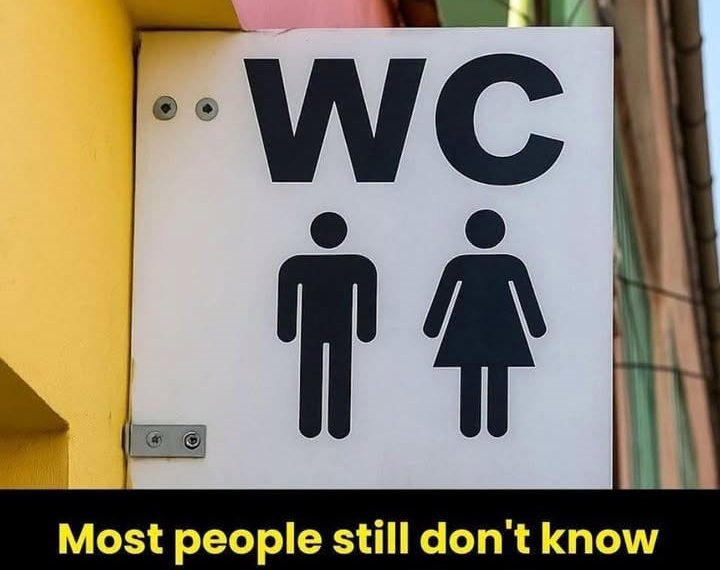
Most people move through their day without pausing over the small signs that surround them. A stop sign, a fire exit, a speed limit – these we understand instantly. But there’s one sign that appears in train stations, airports, hotel lobbies, and restaurants across dozens of countries, and most people who walk past it have no idea what it actually says. Two letters. Enormously common. And almost entirely unexplained.
Those letters are WC.
Ask ten people what WC stands for, and you’ll get a fascinating mix of silence, guesses, and confidently wrong answers. A 2026 discussion documented by British Brief found that social media users across the UK expressed genuine shock when they finally learned the truth, with some admitting they’d assumed it meant “wheelchair” for years. One person revealed they had always believed WC stood for “wheelchair,” while others expressed surprise at having lived with WC signs for decades without questioning their meaning. The real answer is simpler than most people expect, but the story behind it is considerably more interesting.
What WC Actually Stands For
WC stands for “Water Closet.” The term is exactly what it sounds like: a small, enclosed room fitted with a flushing toilet that used water to carry waste away. These compact spaces became known as “water closets” because they were literally tiny closets containing water-operated toilets. At the time, bathing areas were usually separate from sanitation spaces, meaning the modern idea of a combined bathroom had not yet fully developed.
History enthusiasts have clarified that WC stands for “water closet,” a term specifically created during the Victorian era to avoid social embarrassment when discussing toilet facilities. Originally known as the “wash-down closet,” everyday usage gradually transformed it into “water closet,” which eventually shortened to the now-familiar abbreviation WC.
So why a “closet”? In 19th-century English, “closet” referred to any small private room, not a wardrobe or storage space. When flush toilets were installed in homes, they typically occupied their own tiny, separate room. Add water, and you had a water closet. The abbreviation followed naturally.
The Surprisingly Deep History Behind Those Two Letters
The story of the WC doesn’t start in Victorian England. It begins much earlier, with a poet who happened to be a godson of Queen Elizabeth I.
The first modern flush toilet was described in 1596 by Sir John Harington, an English courtier and the godson of Queen Elizabeth I. Harington invented both a valve at the bottom of the water tank and a wash-down system. However, it was not widely adopted because there was no reliable supply of running water to flush it. The queen reportedly had one installed, but the contraption still drained into an open cesspit below, meaning the smell largely defeated the purpose.
The invention sat largely dormant for nearly two centuries. Then, in 1775, a Scottish watchmaker named Alexander Cumming solved the problem that had been holding indoor plumbing back. Cumming was the first to patent a design of the flush toilet in 1775. As well as improving the flush mechanism, he included an S-trap to retain water permanently within the waste pipe, thus preventing sewer gases from entering buildings – a design feature still found in most modern flush toilets.
That S-trap, a curved section of pipe that holds a small pool of water after every flush, is the reason your bathroom doesn’t smell like a sewer. It also made indoor toilets genuinely livable for the first time. You can check yours right now by looking at the visible curve of pipe below or behind the bowl.
In the Victorian era, as urban populations exploded and the importance of sanitation gained recognition, engineers and inventors developed new ways to manage human waste more efficiently. At first, these water closets were exclusive to wealthy families and grand hotels, serving as luxury amenities that signaled status and sophistication.
The gradual spread of indoor plumbing through the Victorian era coincided with a very particular social concern: how to talk about this new fixture without embarrassment. Using “water closet” sounded much more refined than directly referencing the toilet, which was often considered a taboo subject in polite society. The abbreviation WC, two steps removed from the bodily function it referred to, was considered acceptably vague – sufficiently detached from its actual function to be mentioned in conversation without too much discomfort.
How WC Conquered the World
Once the term took hold in Britain, it moved fast. The term gained popularity through the growth of public facilities such as train stations, hotels, and department stores, where clear and polite signage was necessary. WC became a standard marker on signs across the country, and its use persisted even as toilet designs and plumbing systems evolved.
In continental Europe, particularly in Germany, the Netherlands, and Scandinavian countries, the abbreviation was widely adopted and eventually became a recognized toilet identifier far beyond the British Isles. From there, it spread further. In many Asian countries, the same abbreviation has been adopted in public spaces to accommodate international travelers and create a sense of familiarity.
The reason WC crossed so many language barriers so easily is that it doesn’t try to mean anything in most languages. It’s just two neutral letters. Travelers from different countries could recognize them regardless of what word they personally used for toilet facilities. That universal quality is precisely why WC became the go-to label in hotels, airports, rail stations, and public buildings across Europe, Asia, and beyond.
This matters more than it might seem. Someone visiting another country for the first time may search desperately for a “bathroom” sign without realizing the building only labels facilities as “toilets,” “lavatories,” or “WC.” Knowing what those letters mean can save a lot of frantic scanning in a crowded foreign airport.
See the video in page 2