

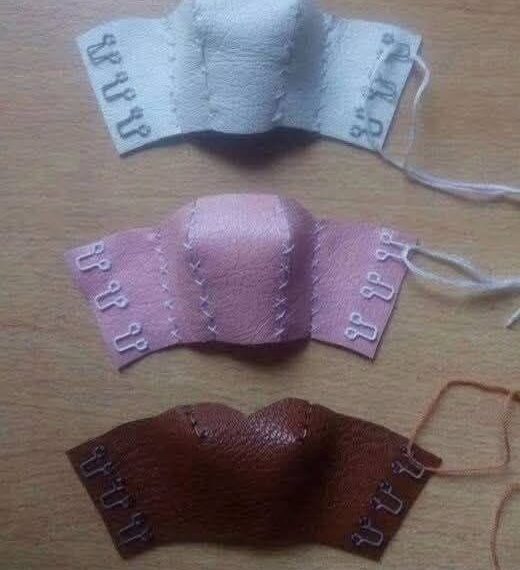
At first glance, these unusual little objects might look like miniature leather cushions, tiny accessories, or even handmade pieces of traditional clothing. They come in different colors, have an oddly raised center, and feature several small loops or fasteners along their edges.
But why would anyone make something with such an unusual shape? And what purpose does the raised section serve?
These intriguing objects appear to be traditional protective accessories associated with sewing, leatherwork, or other forms of hand craftsmanship. Their unusual construction suggests that they were designed to protect the hands from repeated pressure and friction during manual work.
Although their exact name and historical origin are not confirmed, their design offers some interesting clues about the practical needs of traditional craftspeople.
The Unusual Raised Section Has a Purpose
The most noticeable feature is the rounded, padded section in the middle. Unlike ordinary flat pieces of leather, these objects have a raised area that appears to provide additional protection or cushioning.
When working with thick materials, craftspeople often need to apply considerable pressure with their fingers or hands. Repeatedly pushing needles, handling stiff leather, or manipulating several layers of fabric can put considerable strain on the skin.
A padded protective accessory can help distribute that pressure over a larger area, reducing direct contact between the hand and the material being handled.
The raised section may therefore serve as a protective or pressure-bearing surface, although its precise function would depend on how the object is worn.
Why Leather Was a Popular Material for Traditional Crafts
Leather has been used for centuries to manufacture practical tools, protective equipment, clothing, and accessories.
There are several reasons why craftspeople favored it:
- Durability: Leather can withstand repeated friction and handling without wearing out as quickly as many ordinary fabrics.
- Flexibility: It can bend and adapt to the shape of the hand while remaining relatively strong.
- Protection: Thick leather provides a useful barrier against rough surfaces, sharp edges, and repeated pressure.
- Adaptability: It can be cut, stitched, shaped, and modified to create accessories for very specific tasks.
These qualities made leather particularly useful in traditional workshops, where many jobs required repetitive manual work.
What Are the Small Loops Along the Edges For?
Another interesting detail is the series of small openings and loops arranged along both sides of each piece.
They suggest that the objects were designed to be attached, fastened, or adjusted rather than simply placed on a surface.
Depending on their original construction, these fastenings could help secure the accessory around a finger or another part of the hand.
The presence of what appears to be a cord on some examples also suggests that the pieces could be tied or adjusted to remain in position during use.
This is an important feature because protective equipment needs to stay securely attached while someone is working with their hands.
Traditional Sewing and Leatherworking Required Specialized Tools
Before modern machinery became widely available, many everyday products were manufactured almost entirely by hand.
Tailors, shoemakers, leatherworkers, upholsterers, and other artisans relied on specialized tools to make repetitive tasks easier and safer.
For example, traditional sewing thimbles protected fingertips from needle pressure, while leather finger guards and palm protectors could help with more demanding manual tasks.
Working with thick leather was particularly challenging. Unlike lightweight cotton, leather can be difficult to penetrate, especially when several layers need to be joined together.
Craftspeople therefore developed different ways of protecting their hands and improving their ability to apply pressure.
Not every protective accessory looked the same. Some were made from metal, others from leather, and some combined several materials to provide additional comfort and durability.
A Simple Design That Reflects Practical Ingenuity
continue reading in page 2


